
A Bad Company Can Destroy Even a Skilled Marketer
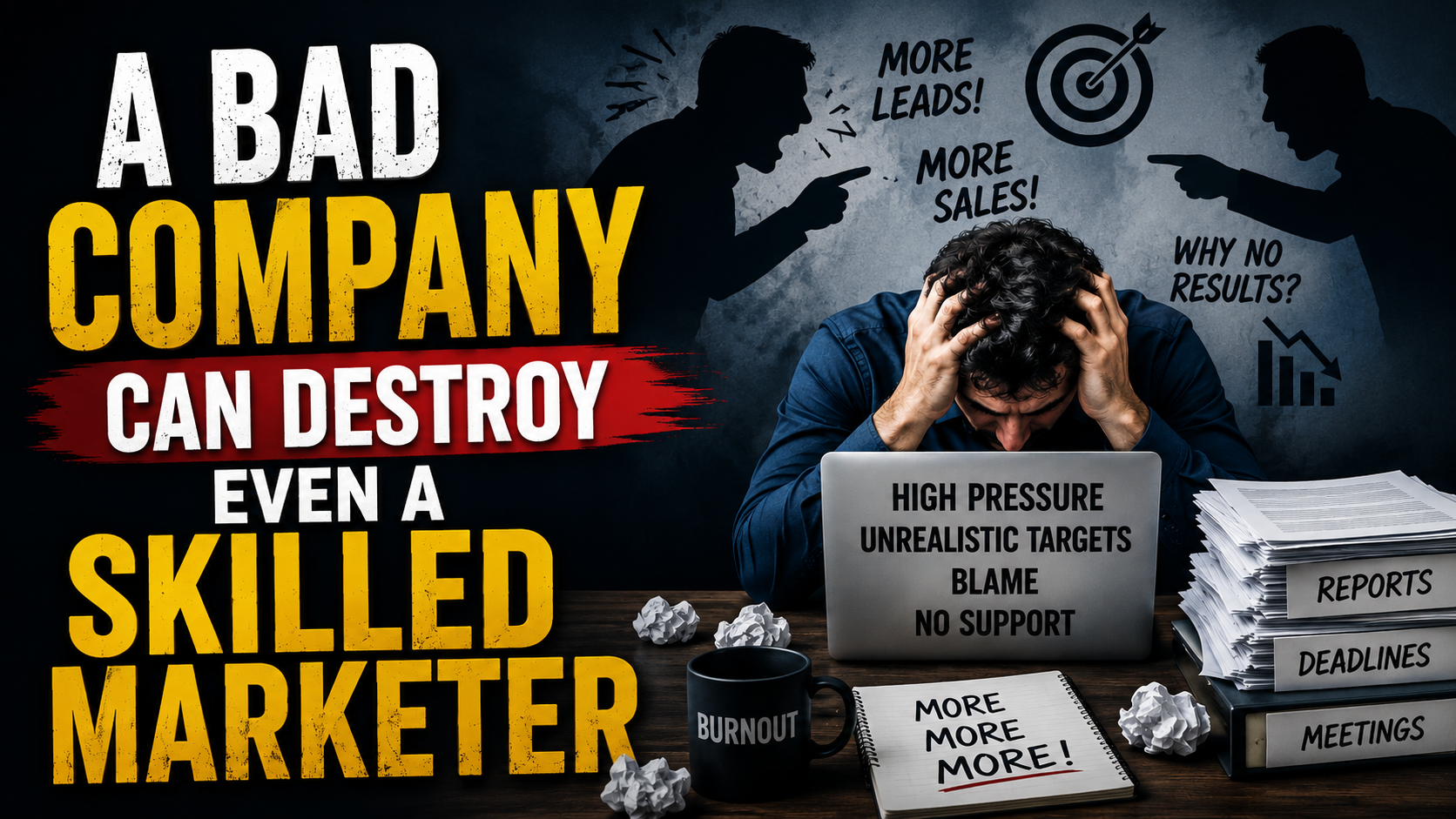
The digital marketing industry often talks about skills, certifications, AI tools, performance frameworks, and growth hacks. But one reality is rarely discussed openly:
A highly skilled marketer can still fail inside a bad company.
Many experienced marketers blame themselves when campaigns do not perform, revenue targets are missed, or pressure keeps increasing despite continuous effort. In reality, the problem is not always the marketer. Sometimes, the company itself creates an environment where sustainable marketing success becomes nearly impossible.
Modern marketing is not magic. It is a combination of strategy, systems, execution, sales alignment, customer experience, data analysis, and long-term consistency. When a company lacks understanding in these areas, even the best marketers struggle to produce meaningful results.
The Biggest Mistake: Treating Marketing Like Instant Revenue Machinery
Some founders believe digital ads work like an ATM machine:
- Put money into ads
- Receive instant customers
- Scale infinitely overnight
This mindset is one of the fastest ways to destroy both marketing performance and employee morale.
Advertising platforms do not guarantee success. Google Ads, Meta Ads, SEO, or automation tools are only channels. Their effectiveness depends on:
- Product-market fit
- Pricing
- Customer trust
- Sales process
- Landing page quality
- Competition
- Offer positioning
- Operational efficiency
If the business fundamentals are weak, no marketing campaign can permanently solve the problem.
Founders Who Think Ads Are Magic
One major red flag is when leadership believes marketing alone is responsible for the entire business outcome.
In such companies:
- Sales teams delay lead follow-ups
- Websites convert poorly
- Customer support is weak
- Products lack differentiation
- Retention systems do not exist
Yet all pressure is pushed onto the marketing department.
When campaigns fail, marketers are blamed. When campaigns succeed, expectations become unrealistic.
This creates a cycle where marketers are constantly firefighting instead of building sustainable growth systems.
Companies That Do Not Understand CAC and LTV
Many businesses want growth but do not understand the economics behind growth.
Two of the most important metrics in modern marketing are:
- Customer Acquisition Cost (CAC)
- Lifetime Value (LTV)
A mature company understands:
- How much it costs to acquire customers
- How long profitability takes
- How retention impacts revenue
Immature companies ignore these fundamentals and expect immediate profitability from every campaign.
For example:
- Spending ₹ 1,000 to acquire a customer worth ₹ 50,000 long-term may be profitable
- But companies focused only on instant returns will panic early and stop campaigns prematurely
Without understanding CAC and LTV, marketing decisions become emotional instead of strategic.
The "10x ROI Instantly" Problem
Another dangerous mindset is expecting unrealistic returns in extremely short timeframes.
Some companies expect:
- 10x ROI in the first month
- Explosive sales with small budgets
- Premium-quality leads at the lowest possible CPL
- Market domination without proper investment
In reality, strong marketing usually requires:
- Testing
- Optimization
- Audience learning
- Creative improvements
- Conversion tracking
- Funnel refinement
- Patience
Sustainable growth is built through iteration, not miracles.
Businesses that demand instant perfection often create unstable environments where marketers cannot execute properly.
Constantly Changing Goals Destroy Momentum
Marketing performance depends heavily on consistency.
However, some companies:
- Change target audiences weekly
- Shift branding direction monthly
- Replace strategies before enough data is collected
- Constantly introduce "new ideas" without process
This creates chaos.
A campaign cannot mature if:
- Offers keep changing
- Landing pages change every few days
- Reporting expectations shift continuously
- Priorities change without warning
Good marketing requires time to collect data and optimize intelligently.
Without consistency, even experienced marketers cannot build predictable systems.
Measuring Marketing Daily Is a Huge Mistake
One of the biggest signs of low marketing maturity is daily panic over performance fluctuations.
Marketing data naturally fluctuates because of:
- Audience behavior
- Bidding systems
- Seasonality
- Competition
- Platform learning phases
- External market conditions
Companies that analyze campaigns emotionally every single day usually:
- Interrupt optimization cycles
- Make rushed decisions
- Reduce budgets too quickly
- Damage long-term performance
Professional marketing requires trend analysis over meaningful timeframes, not emotional reactions to daily metrics.
Underinvesting While Expecting Market Domination
Some businesses want industry-leading growth while operating with:
- Minimal budgets
- Weak teams
- Outdated tools
- Poor creatives
- Unrealistic hiring structures
They expect one marketer to manage:
- SEO
- Paid ads
- Content
- Social media
- Automation
- Analytics
- Design
- CRM
- Video editing
- Reporting
This approach leads to burnout, poor execution quality, and declining results.
Growth requires investment:
- In systems
- Talent
- Testing
- Technology
- Infrastructure
Companies that refuse to invest properly usually create pressure instead of performance.
A Skilled Marketer Needs the Right Environment
Even highly experienced marketers need:
- Realistic expectations
- Strategic alignment
- Proper resources
- Operational support
- Long-term thinking
Marketing works best when:
- Sales and marketing collaborate
- Leadership understands data
- Experimentation is encouraged
- Growth is viewed as a process rather than instant magic
The best marketers are not necessarily working in the loudest companies. Often, they are working in businesses that understand patience, systems, and sustainable scaling.
Final Thoughts
Many marketers spend years believing they are underperforming, when in reality they are working inside environments designed for failure.
A bad company can:
- Destroy confidence
- Damage career growth
- Create burnout
- Make talented professionals question their abilities
That is why choosing the right company matters just as much as developing the right skills.
The future belongs to marketers who:
- Understand business deeply
- Focus on systems instead of shortcuts
- Work with companies mature enough to support sustainable growth
Because great marketing cannot survive long inside broken business thinking.